

As a part of the ongoing research project “Developing women’s role in policy-making processes: shaping gender equity and inclusiveness in climate action for health and wellbeing in Nepal (WeSHAPE)”, the research team at PHASE Nepal recently conducted a two day participatory policy making workshop 16 and 17 January at the Hotel City Gaon, Bhaktapur.
The event brought together key stakeholders from Panchpokhari Thangpal Rural Municipalityto collectively discuss and refine the local Climate Change Adaptation Policy, with a strong emphasis ongender equity, inclusiveness, and community-led policy processes. it was attended by twenty participants, including elected political representatives (such as rural municipality chairperson and ward representatives), members of legislative committees, and representatives from different sections including health, agriculture, environment and women’s affairs as well as FCHV and health workers. A pre-drafted policy based on the input provided by the community members and the findings of the research was shared with the participants.
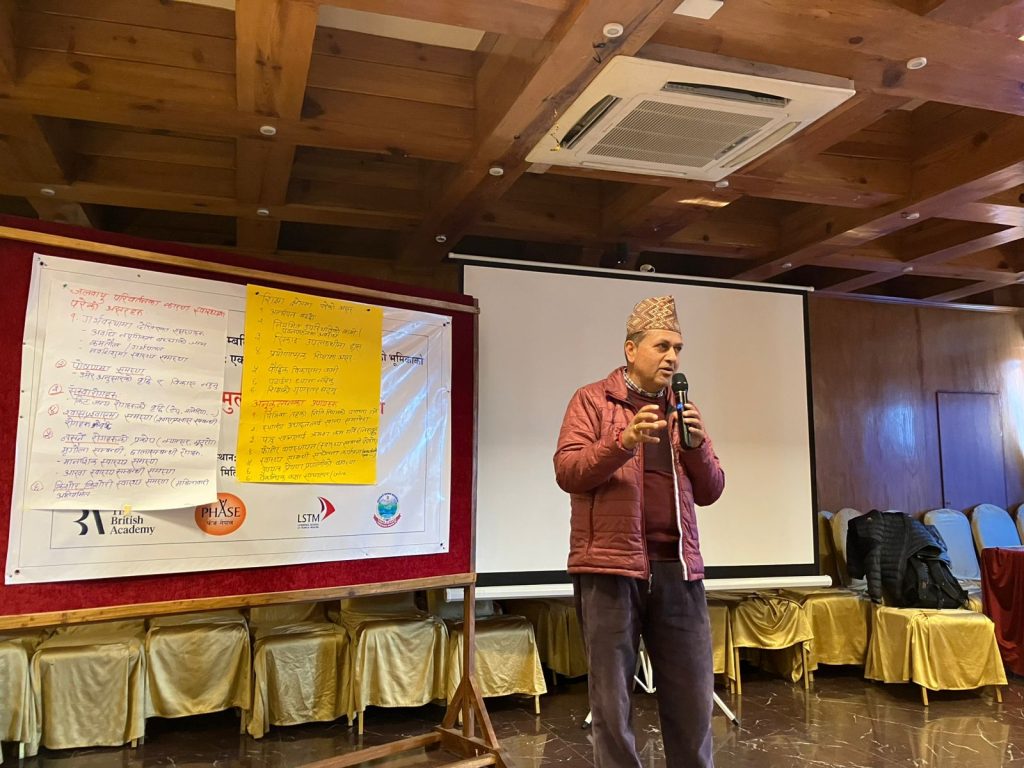
During this session, the Chairperson of the Rural Municipality reinforced the need to create inclusive policy processes, where both women and men could work together in order to promote the sustainable development of Panchpokhari.
The two day workshop focused on the practical aspects of participatory policy-making. Active discussions among the key stakeholders emphasized the importance of developing local climate change policies, with particular focus on the need for the context specific climate change adaptation policies tailored to Panchpokhari Thangpal Rural Municipality. Participants highlighted that locally grounded policies are essential to address the unique environmental and health challenges faced by the community.
The workshop divided the participants into different groups and had them discuss regarding four different thematic areas based on their areas of expertise: agriculture, education, environment, health, infrastructure and disaster risk reduction. Participants actively engaged in group brainstorming to identify priority climate-related risks, cross-cutting issues, and feasible policy responses to support the development of a comprehensive and inclusive local climate change adaptation policy. Each of the group presented the major problems faced in their thematic group and provided subsequent recommendations that can be incorporated to the draft climate change adaptation policy.
The initial draft of the Panchpokhari Climate Adaptation Policy 2082 came out from the year-long engagement in Thangpal municipality, including community engagement, sectoral discussions and local evidence from workshops such as this one.
Participants reflected on the relevance of the program and the importance of developing policies that reflect community realities. The discussions also highlighted the role of women in decision-making, sustainable development, and practical implementation of Climate Change Adaptation Policy.

One of the participant, Chief of the Women’s Development Section, shared her thoughts:
“I feel these discussions have been very useful and fruitful. We should apply what we have learned in real life, not just in discussions. I hope these sessions are equally helpful to all my fellow participants.”
Ward chairperson from one of the wards of Pachpokhari Thagpal RM noted,
“Over the last two days, we talked about how climate change affects different sectors and realized how important it is to develop effective policies to tackle these challenges. Policies alone are not enough if they are not implemented properly. Our future policies need to reflect the real situations faced by communities. Once again, I am sincerely thankful to the organizing committee.”
Overall the workshop was a success with the participants demonstrating strong motivation to move forward with the draft policy after incorporating recommendations from the discussions. The PHASE Nepal team hopes that the learning and outcomes from this workshop will meaningfully inform future policy-making processes within the rural municipality and ensure that climate change remains a key thematic area in upcoming local policies.